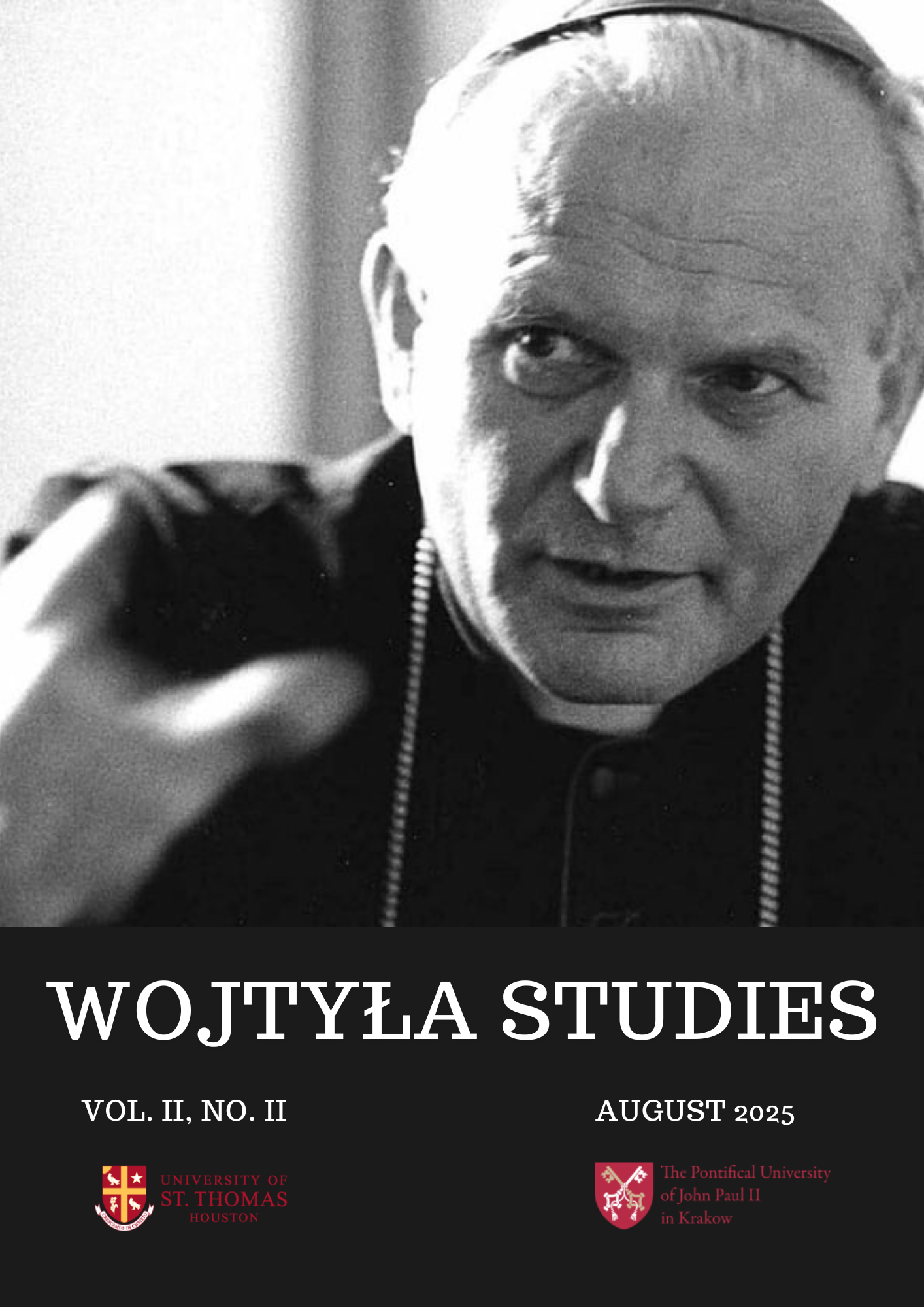
Divinus in Caro: Karol Wojtyła’s Ontological Personalism Between Theomorphism and Technomorphism
Keywords:
personalism, theomorphism, technocracy, efficacy, self-determination, human dignityAbstract
Modernity’s crisis of human self-understanding has been characterized by two opposed reductions of the person. On one side, a theomorphic tendency frames the human being exclusively in relation to the divine, often at the expense of the creature’s own integrity and agency. On the other, a technomorphic tendency reduces the person to a manipulable object of technology and biology, flattening human existence to measurable functions. This paper argues that Karol Wojtyła’s ontological personalism mediates these extremes through a deeper retrieval of the person as divinus in caro—the divine image manifested in flesh. Wojtyła’s philosophy of the acting person, centered on efficacy, self-determination, and transcendence of the person in act, both affirms the human orientation to God (thus correcting technocratic reductionism) and insists on the creaturely reality and freedom of the person (thereby correcting one-sided theocentrism). In four parts, the argument unfolds the anthropological dilemmas of theomorphism and technomorphism and shows how Wojtyła’s integration of classical metaphysics with phenomenology preserves the irreducible uniqueness and dignity of the human person, offering a philosophical defense of the person as both subject and end of moral action.
Downloads
References
Acosta, M., Reimers, A.J., Karol Wojtyła’s Personalist Philosophy: Understanding Person and Act (Washington, D.C.: The Catholic University of America Press, 2016).
Aguas, J.J., Person, Action, and Love: The Philosophical Thoughts of Karol Wojtyła (John Paul II) (Manila, Philippines: UST Publishing House, 2014).
Collins, J., God in Modern Philosophy (Chicago, USA: Henry Regenery Company, 1959).
Crosby, J.F., Personalist Papers (Washington, D.C.: Catholic University of America Press, 2004).
Del Noce, A., The Age of Secularization, ed. and trans. by C. Lancellotti (Montreal: McGill-Queen’s University Press, 2017).
Foster, D.R., Koterski, J.W., (eds.), The Two Wings of Catholic Thought: Essays on Fides et Ratio (Washington, D.C.: Catholic University of America Press, 2003).
Gawande, A., Being Mortal: Illness, Medicine and What Matters in the End (London: Profile Books, 2014).
Hanby, M., No God, No Science? Theology, Cosmology, Biology (Chichester: Wiley-Blackwell, 2013).
Harari, Y.N., Homo Deus: A Brief History of Tomorrow (London: Harvill Secker, 2016).
Harari, Y.N., Nexus: A Brief History of Information Networks From the Stone Age to AI (New York: Random House, 2024).
Hołub, G., Understanding the Person: Essays on the Personalism of Karol Wojtyła (Bern: Peter Lang, 2021).
Ignatik, G., Person and Value: Karol Wojtyła’s Personalistic and Normative Theory of Man, Morality, and Love (Lanham: Lexington Books, 2021).
John Paul II, Centesimus Annus (The Holy See, May 1, 1991).
John Paul II, Fides et Ratio (The Holy See, September 14, 1998).
John Paul II, Letter to Families (The Holy See, February 2, 1994).
John Paul II, Redemptor Hominis (The Holy See, March 4, 1979).
Lewis, C.S., The Abolition of Man (New York: HarperCollins Publishers, 2015).
Lubac, H. de, The Drama of Atheist Humanism, trans. by E. Riley (San Francisco: Ignatius, 1995).
Nietzsche, F., Beyond Good and Evil, trans. by J. Norman (Cambridge: Cambridge University Press, 2001).
Nietzsche, F., On the Genealogy of Morals, trans. by W. Kaufmann, R.J. Hollingdale (New York: Vintage, 1989).
Pascal, B., Pensées, trans. by H. Levi (New York: Oxford University Press, 1995).
Reimers, A.J., Truth About the Good: Moral Norms in the Thought of John Paul II (Ave Maria, Fla.: Sapientia Press, 2011).
Schindler, D.C., God and The City (Indiana: St. Augustine’s Press. 2023).
Smith, Ch., “On ‘Moralistic Therapeutic Deism’ as U.S. Teenagers’ Actual, Tacit, De Facto Religious Faith,” in: Soul Searching: The Religious and Spiritual Lives of American Teenagers (Oxford University Press, 2005).
Tongeren, P. Van, Reinterpreting Modern Culture: An Introduction to Friedrich Nietzsche’s Philosophy (West Lafayette: Purdue University Press, 2000).
Vatican Council II, Pastoral Constitution on the Church in the Modern World, Gaudium et spes (The Holy See, December 7, 1965).
Wojtyła, K./John Paul II, Man and Woman He Created Them: A Theology of the Body, trans. by M. Waldstein (Boston: Pauline Books, 2006).
Wojtyła, K., Love and Responsibility, trans. by G. Ignatik (Boston, Pauline Books & Media, 2013).
Wojtyła, K., Person and Act and Related Essays, “The English Critical Edition of the Works of Karol Wojtyła/John Paul II,” vol. 1, ed. A. Lopez, trans. by G. Ignatik (Washington, D.C.: Catholic University of America Press, 2021).
Wojtyła, K., The Lublin Lectures and Works on Max Scheler, “The English Critical Edition of the Works of Karol Wojtyła/John Paul II,” vol. 2, ed. A. Lopez, trans. by G. Ignatik (Washington, D.C.: Catholic University of America Press, 2023).